
REVIEW · DMZ & BORDER TOURS
Best 2 Days Guided DMZ and Seoul City Tours from Seoul
Cross a line most people never see. This 2-day guided combo pairs a tightly run DMZ day with classic Seoul stops like Gyeongbokgung and Insadong, with an air-conditioned ride and included entry. It is the kind of itinerary that gives context fast, then lets you see the places that shaped the Korean story.
I especially liked the DMZ route, because it is not just photo stops. The sequence through Imjingak Pyeonghoa-Nuri Park, the Bridge of Freedom, the 3rd Infiltration Tunnel, and finally the Dora Observatory helps the information click in the right order.
One possible drawback: English can be uneven, and you can end up with more unstructured free time than you expect. At some stops, you may struggle to read signs or understand details on your own.
In This Review
- Key Things You Will Notice on This 2-Day Tour
- Price and What You Actually Get for $110
- Your Two-Day Format: How the Pieces Fit Together
- Day 1 DMZ Stops: From Imjingak Remembrance to Dora Observatory Views
- Imjingak Pyeonghoa-Nuri Park and Its Refugee Memory
- Bridge of Freedom: The Return of Prisoners
- The Third Infiltration Tunnel: Comfort Check Before You Go
- DMZ Theater: A Short Video That Sorts Out the Big Picture
- Dora Observatory: Binocular Viewing on a Clear Day
- Day 2 Seoul Highlights: Temples, Royal Palaces, and Museum Time
- Jogyesa Temple: Downtown Buddhism and the Iljum Gate
- Gyeongbokgung Palace: Built 1395, Restored Again and Again
- National Folk Museum of Korea: 500 Years in Artefacts
- Insadong Arts and Crafts Market: Hand-Made Souvenirs and Snack Stops
- Namdaemun Market: Old Seoul Meets Modern Goods
- Ginseng Museum: A Quick, Free Stop
- How This Tour Runs in Real Life: Timing, Vehicle Comfort, and Language Gaps
- Who Should Book This 2-Day Combo Tour
- Should You Book This Tour?
- FAQ
- What time does the tour start?
- How long is the tour?
- How much does it cost?
- Is pickup offered?
- Does the tour include admission tickets and fees?
- Is lunch included?
- Is there a mobile ticket?
- What is the maximum group size?
- Are any stops closed on Tuesdays?
Key Things You Will Notice on This 2-Day Tour
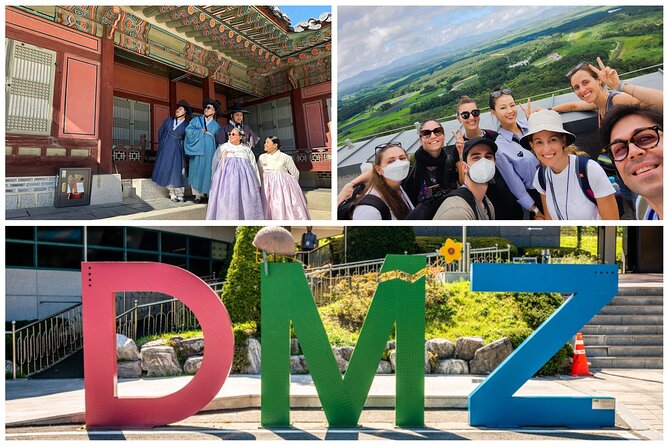
- Imjingak Pyeonghoa-Nuri Park: the Iron Horse train, Mangbaedan altar rituals, and the Unification Pond
- Bridge of Freedom: built for the return of 12,773 liberated prisoners in 1953
- 3rd Infiltration Tunnel: a real, enclosed space with listed dimensions and a guided walk-through option
- Dora Observatory: binocular viewing aimed toward the propaganda village inside the DMZ and toward Gaesong on clear days
- Gyeongbokgung Palace: Joseon’s main palace (built 1395, restored after major destruction)
- Insadong plus Namdaemun: hand-crafted arts shopping mixed with bigger, louder market browsing, plus a free ginseng stop
Other routes to the border, side by side
Price and What You Actually Get for $110
At $110 per person for about 2 days, this tour is priced for convenience and structured access. You are not just buying “transport plus views.” The itinerary includes admission tickets for the listed stops, plus all fees and taxes and an air-conditioned vehicle.
That matters in Seoul, because the hard part is not getting places on a map. The hard part is doing it efficiently with a route that makes sense, without wasting your day hunting transit, figuring out which sites are closed, or missing key viewpoints.
Also, this is a guided experience with pickup offered and a mobile ticket. For a first visit, that removes a lot of friction. For repeat visitors, it is still useful if you want the DMZ logistics handled for you.
Your Two-Day Format: How the Pieces Fit Together
This is a classic “big context, then real sites” structure.
- Day 1 focuses on the DMZ area, moving from reconciliation symbolism to physical remnants of conflict, then ending at the closest major observation point.
- Day 2 is built around Seoul highlights, starting with a living Buddhist temple scene, then shifting to royal-era heritage and museum time, and finishing with shopping and a quick ginseng stop.
Timing-wise, the day starts at 9:00 am and ends back at the meeting point. There is also a maximum group size of 100, so you are not in a tiny private bubble, but it is also not chaotic.
Day 1 DMZ Stops: From Imjingak Remembrance to Dora Observatory Views
Day 1 is emotionally intense, but it is organized in a way that helps you stay oriented. The stops are close to the “route logic” you want: remembrance and history, then the physical sites, then the look across the border.
Imjingak Pyeonghoa-Nuri Park and Its Refugee Memory
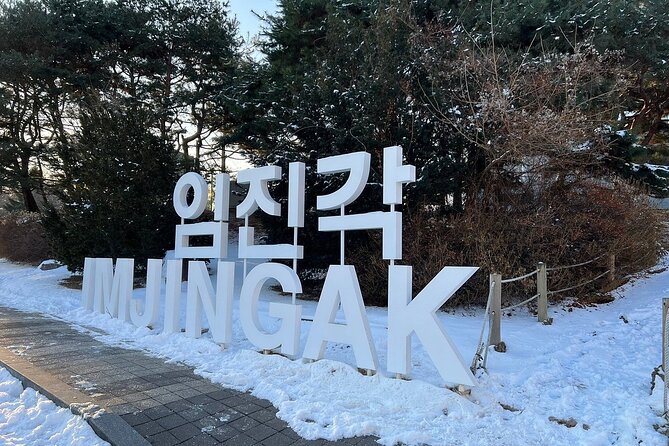
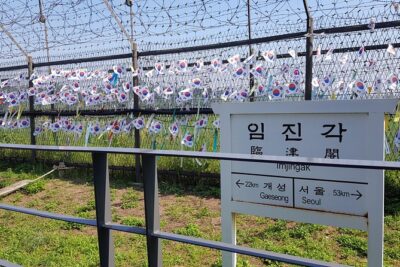
Imjingak Pyeonghoa-Nuri Park is where the tour starts by grounding you in the human impact of war. You will see the Iron Horse train display inside the park. The rail link between the two Koreas existed before the conflict, and it was taken apart during the war.
Then there is the Mangbaedan altar, where refugees bow toward the direction of the graveyard. The tradition is connected to Chuseok (Korean Thanksgiving). The symbolism is heavy, but it is also practical to understand once you know what you are looking at.
Two more photo-friendly highlights are built for visitors: the Unification Pond, shaped like the Korean peninsula, and the Peace Bell. Expect about 20 minutes here.
Tip for you: if you care about meaning, spend a minute asking your guide what to notice around the altar and the pond before you start taking pictures. It will change how your photos read later.
More days where a guide does the work in Seoul
- Seoul: Night Market Food Tour with Local Guide
★ 4.9 · 943 reviews - DMZ Guided Tour with Suspension Bridge / Gondola from Seoul
★ 5.0 · 876 reviews - Downtown Seoul Guided Food & Market Tour with 8+ Local Tastings
★ 5.0 · 580 reviews - Seoul: DMZ Guided Tour with Suspension Bridge and Gondola
★ 4.9 · 553 reviews - Flexible Private Guided Tour in Seoul (Optional Incheon Layover)
★ 5.0 · 323 reviews
Bridge of Freedom: The Return of Prisoners
From Imjingak, you move to the Bridge of Freedom. This is tied to a specific historical event: the bridge was built to liberate 12,773 prisoners in 1953. It also relates to South Koreans returning home from the North.
Walking across this bridge gives you a different kind of perspective than watching from a viewpoint. You are moving through a space linked to release and return, not just a marker on a map.
It is also set against a scenic backdrop, so it is a straightforward place to get those “I am really here” shots. The stop is about 20 minutes, with admission ticket included.
Consideration: you will likely want more time than the clock allows. If that matters to you, prioritize photos first, then do quick reading after with your guide’s help.
The Third Infiltration Tunnel: Comfort Check Before You Go
Next is the 3rd Infiltration Tunnel, discovered in 1978. It is located about 12 kilometers from Munsan and about 52 from Seoul, so it is far enough to feel like you truly left the city behind.
The tour includes a walk-through experience here, and the provided details are specific: it is listed as 1,635 meters long, roughly 2 meters high, and 2 wide. The stated capacity is moving an entire division per hour.
The context is part of why this stop hits hard. The tunnel was meant for an invasion route, and when it was discovered, there were claims from the North that the South built it as a surprise attack. Evidence provided by the tour explanation points the other way.
The time allocation is about 30 minutes, with admission ticket included. If you are not comfortable in closed spaces, plan to wait by the exit and still get the full historical framing from your guide.
DMZ Theater: A Short Video That Sorts Out the Big Picture
After the tunnel, the itinerary shifts back to explanation. At the DMZ Theater, you watch a short 7 to 8 minute video about the conflict and the DMZ’s creation.
This is useful because the tunnel can be physically intense, but the video helps you connect the how and why. The video also gives background on the infiltration tunnels North Korea dug, so the tunnel stop feels less like a random detour and more like part of a bigger system.
The theater stop is about 20 minutes, with admission ticket included.
Dora Observatory: Binocular Viewing on a Clear Day
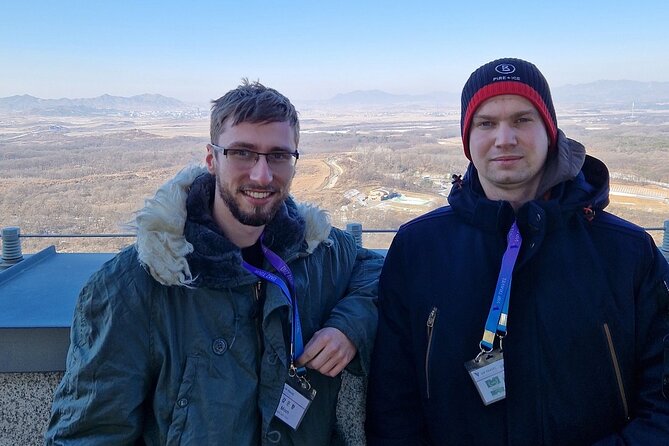
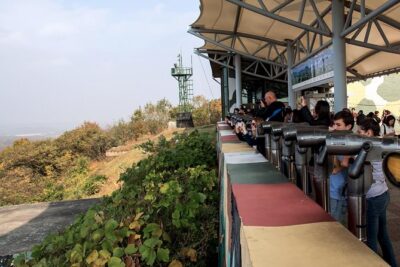
The final DMZ stop is the Dora Observatory. It sits on top of Dorasan and is one of the most popular highlights for a reason. This is the area closest to the North, and the views are built for visitors to interpret what they are seeing.
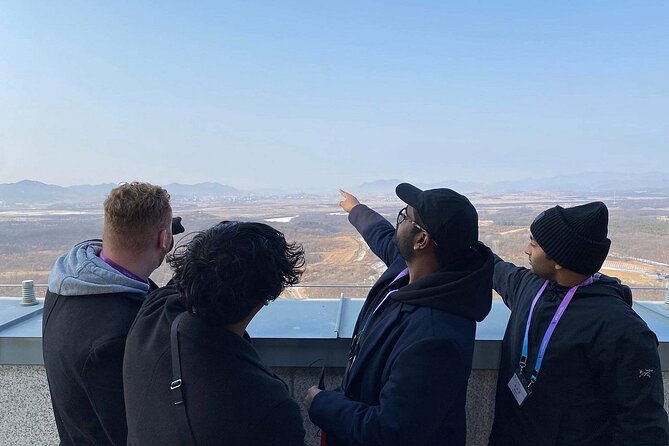
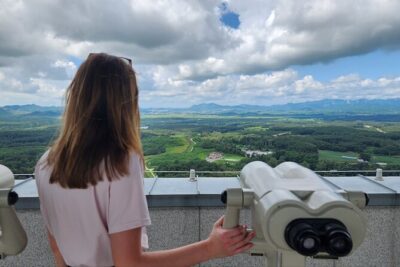
On the third floor, you can use high-powered binoculars for extra precision. The tour describes what you might spot: a propaganda village inside the DMZ, views as far as Gaesong (described as the ninth-largest city in North Korea), and, on a clear day, possibly the bronze statue of Kim Il-sung.
The Dora stop is about 30 minutes, with admission ticket included.
Practical tip: if the weather looks iffy, manage expectations. If it is clear, this part is where the whole tour turns from history class into a real-world viewpoint.
Day 2 Seoul Highlights: Temples, Royal Palaces, and Museum Time
Day 2 is more traditional Seoul sightseeing, but it is still structured. You start with a working religious site, then move to Joseon-era royal heritage, then to artifacts and arts, and finish with market browsing.
Jogyesa Temple: Downtown Buddhism and the Iljum Gate
Your first stop is Jogyesa Temple in downtown Seoul. It is one of the most important landmarks of Korean Buddhism, first established in 1935.
A big visual marker you may notice immediately is the ancient white pine tree on-site. There is also a traditional entry sequence. You go through Iljum, the one pillar gate. The Iljumun symbolizes the division between the world of the living and the holy Buddha world.
Inside, you can admire golden statues and experience the calm contrast between the temple grounds and the city outside. The stop is about 40 minutes, with admission ticket included.
Tip for you: wear footwear that works for slow walking and uneven stone. Temples are easy when you do not rush, and this one sits in the middle of a real neighborhood.
Gyeongbokgung Palace: Built 1395, Restored Again and Again
Next is Gyeongbokgung Palace, with a note that it is closed on Tuesdays. This palace was the main home of the Joseon Dynasty, constructed in 1395, and it is described as having 7,700 rooms.
You will also see reminders that history was not gentle. It was destroyed during the Imjin War (1592 to 1598). Later, Imperial Japan destroyed a large portion in the 20th century. The key point for your visit is that the palace has been restored time and again, so what you see today is the result of repeated rebuilding efforts, not one intact snapshot from the past.
Your time here is about 1 hour 30 minutes, with admission ticket included.
Consideration: palace walking can be tiring if you do not like long indoor-free outdoor walking. Bring a water bottle, and plan to take breaks as needed.
National Folk Museum of Korea: 500 Years in Artefacts
After the palace, you head to the National Folk Museum of Korea. It is closed on Tuesdays as well.
The museum originally started as the Korean Imperial Museum in 1908, with multiple renames and relocations over time. Today, it holds about 45,000 artefacts and royal treasures from Joseon Dynasty palaces and the Korean Empire. The tour description also says there are 14 South Korean National Treasures here.
The stop time is shorter at about 20 minutes, with admission ticket included. Even in a short window, this is one of those places that helps you understand what palace life was like, because it is not only architecture, it is household and everyday material culture.
Insadong Arts and Crafts Market: Hand-Made Souvenirs and Snack Stops
Then you move into shopping territory at Insadong. This is where you will find arts and crafts that are mostly hand-crafted, with a long street of stalls and shops.
Insadong also has small moments that make it fun, like the tour description of a poo-themed cafe. You may also run into food treats, including waffle bars made with matcha and plum tea. If you like browsing alleys, this is a good place to look beyond the main street for ceramics shops and additional snack vendors.
The stop is about 1 hour 30 minutes, with admission ticket included.
Practical tip: if your goal is souvenirs, set a simple budget before you wander. Markets here can tempt you into “just one more stop” decisions fast.
Namdaemun Market: Old Seoul Meets Modern Goods
Next is Namdaemun Market, described as one of Seoul’s oldest and largest markets. It is also located centrally, so it works well after temple and palace time.
Here the variety is the point: you can browse traditional crafts and clothing, but you can also find more modern items like electronics and fashion. It is a lively place to shop, and it is also a place where you will see how Seoul mixes old and new in the same block.
Time here is about 50 minutes, with admission ticket included.
Ginseng Museum: A Quick, Free Stop
Finally, there is 청하고려인삼(주), the Ginseng Museum, for about 30 minutes. This one is listed as free.
Because the tour data only says it is a museum and gives the time and free admission, keep your expectations flexible. Treat it as a short cultural and shopping-adjacent break rather than the main event.
How This Tour Runs in Real Life: Timing, Vehicle Comfort, and Language Gaps
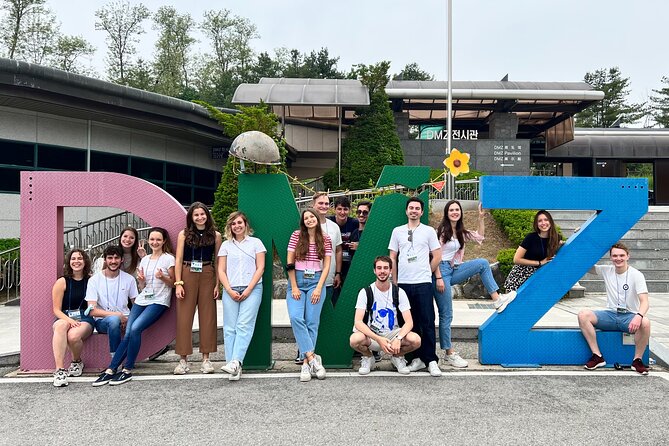
A DMZ plus big-city day means you are moving. The good news is that the tour includes an air-conditioned vehicle and follows a clear stop order. The day starts at 9:00 am, and you get pickup, so you avoid the stress of assembling your own transit plan.
Also, the guide experience seems to be a strong point. In prior experiences with this company, Kelly has been praised for being very knowledgeable and keeping the schedule working. On the DMZ side, Wendy has been praised for keeping everyone on time and focusing on the important parts.
That matters because the DMZ stops can feel confusing if you only rely on your own reading. A guide helps you know what is worth your attention in each space.
Still, there is a real consideration here. One review pointed out that there can be too much free time to walk around and not enough English to read everything. So if you want deeper understanding, do this: before you split off, ask your guide for the top two things to look for at that stop. Then you can browse without feeling lost.
One more practical note: the 3rd Infiltration Tunnel is a closed-space experience. If you are claustrophobic or just uncomfortable in tight quarters, do not force it. The tour description explicitly says you can wait by the exit.
Who Should Book This 2-Day Combo Tour
This tour is a good match if you want:
- A guided DMZ visit that covers key sites like Imjingak, the Bridge of Freedom, the 3rd Tunnel, and Dora Observatory
- Seoul highlights in one package, including Jogyesa, Gyeongbokgung, the National Folk Museum, and shopping time in Insadong and Namdaemun
- Included admissions and fees, so your budget stays simpler
- A structure that helps you understand what you are seeing, especially with the DMZ Theater video after the tunnel
It may not be ideal if you:
- Get very frustrated by language gaps at outdoor stops where signage may not be in English
- Want slow, unstructured pacing at each site, because the route includes set stop times
- Are highly uncomfortable in confined spaces, since the tunnel is a central activity
Should You Book This Tour?
If you want the DMZ experience without dealing with logistics, and you also want a solid Seoul highlight run on the same trip, I think this is a strong value at $110. You are paying for guided organization, air-conditioned transport, and included entry fees across a lot of major stops.
I would book this if your schedule allows it and you are okay with the pace. If you visit on a Tuesday, check the site hours in advance because Gyeongbokgung and the National Folk Museum of Korea are closed on Tuesdays.
Finally, because the tour is commonly booked about 65 days in advance, plan early. The earlier you book, the easier it is to lock in your preferred dates for this very specific two-day combination.
FAQ

What time does the tour start?
The tour starts at 9:00 am.
How long is the tour?
It runs for about 2 days.
How much does it cost?
The price is $110.00 per person.
Is pickup offered?
Yes, pickup is offered.
Does the tour include admission tickets and fees?
Yes, all fees and taxes are included, and admission tickets are included for the listed stops. The Ginseng Museum stop is listed as free.
Is lunch included?
No, lunch is not included. The tour guide will recommend restaurants and menu options.
Is there a mobile ticket?
Yes, the tour uses a mobile ticket.
What is the maximum group size?
The maximum group size is 100 travelers.
Are any stops closed on Tuesdays?
Yes. Gyeongbokgung Palace (except Tuesdays) and the National Folk Museum of Korea (closed on Tuesdays) are not available on Tuesdays.
Keep Browsing Seoul
More Seoul Write-Ups
The Border, Other Routes In
Fresh on the Seoul pile
- Unique Native Experience : Han River Picnic, Board game, BBQ★ 5.0 · 3 reviews
- 2-Hour Private Kayaking and Paddleboarding Experience in Hanriver★ 5.0 · 3 reviews
- Korean Folk Village & Suwon Hwaseong Fortress Private Tour★ 5.0 · 3 reviews
- Seoul Korean BBQ Dinner Experience with Secret Food Tours★ 5.0 · 3 reviews
- Seoul Highlights & Hidden Gems – Private Tour with Photo Service★ 5.0 · 3 reviews
- Night Food Tour in Seoul with Traditional and Modern Cuisine★ 5.0 · 3 reviews
DMZ & Border Tours you might have missed.
 ★ 5.0Best DMZ Tour Korea from Seoul (Red Suspension Bridge Optional)From $2941,422 reviews
 ★ 5.0DMZ Tour: 3rd Tunnel, Option(Suspension Bridge, Boat) from SeoulFrom $3521,373 reviews
 ★ 5.0DMZ tour south Korea from Seoul (NK experience hall, defector)From $2620,599 reviews
 ★ 4.9DMZ Insider Tour: 3rd Tunnel, NK Defector Meet & Red BridgeFrom $5015,214 reviews
 ★ 4.8Seoul: DMZ Tour with Optional Suspension BridgeFrom $455,277 reviews
 ★ 5.0Signature DMZ Tour: Exclusive Defector Talk & Suspension BridgeFrom $274,459 reviews
 ★ 5.0Thrilling Korean DMZ 3rd Tunnel Tour from Seoul + Red Bridge RushFrom $353,097 reviews
 ★ 5.0DMZ Past and Present: Korean Demilitarized Zone Tour from SeoulFrom $372,481 reviews
Where this tour also appears