
REVIEW · SEOUL ROYAL PALACES
Seoul: Deoksugung Palace Night Tour
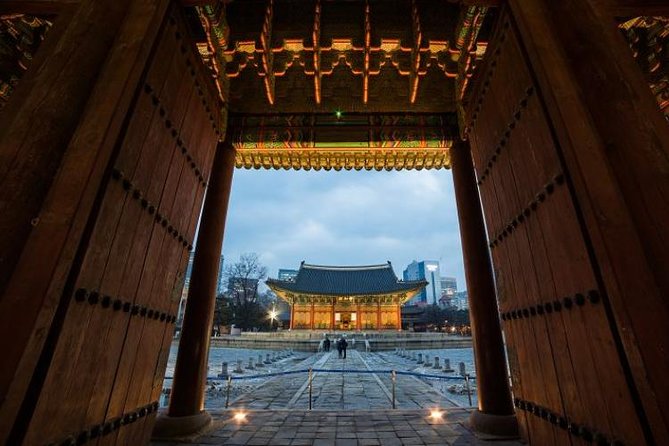
Deoksugung looks different after dark, and you notice why. This 2-hour night tour in central Seoul pairs guided walkthroughs with English and Chinese explanations, so the palace feels less like a building and more like a timeline. I like that you get both traditional halls and the standout Seokjojeon, the Western-style structure that helps explain how Korea tried to modernize in a changing era.
I also really like the feel of the route. You start near City Hall Station, you get a steady sequence of key rooms and courtyards, and the evening lighting brings out details you might miss on a hot midday. A possible drawback is that the palace is closed on Mondays, so you’ll need a backup plan (the operator offers a Gyeongbokgung option instead).
If you’re choosing this because you want peace, story, and architecture in one package, it’s a strong pick. If you’re choosing it mainly for big-ticket sights or long gallery time, it may feel a bit short.
In This Review
- Key things to know before you go
- Why Deoksugung at night feels calmer and more meaningful
- Getting started near City Hall: easy to find, easy to pace
- Junghwajeon: the main throne hall under evening light
- Seokjojeon: the Western-style building that changes the whole frame
- Seokeodang: a favorite building connected to King Gojong
- Hamnyeongjeon: the king’s bed-chamber and the feeling of daily life
- Jungkwanhun: the cafeteria stop that doubles as a Q and A moment
- The stone wall beside Deoksugung: a quick stop you should not skip
- Price and value: $35 for guidance and context, not just entry
- Guides and the difference good storytelling makes
- Who should book this night tour?
- Should you book Deoksugung Palace Night Tour?
- FAQ
- Where do I meet for the Deoksugung Palace night tour?
- How long is the tour?
- Is the palace admission included?
- What languages are the explanations in?
- Is Deoksugung Palace open every day?
- Is recording or filming allowed?
- How large are the groups?
- What happens if weather is bad or not enough people book?
- Can I bring a pet?
Key things to know before you go
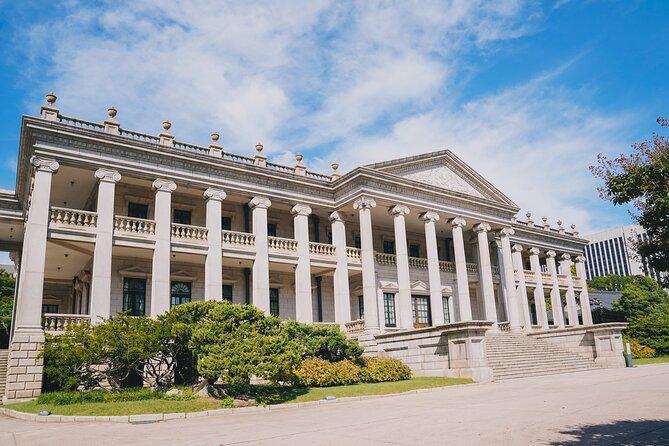
- Night lighting makes the architecture easier to read, especially the mix of styles in the palace grounds
- English and Chinese explanations help you follow the meaning behind the halls, not just the names
- Free admission is part of the deal, so you’re paying for guidance and time, not entry fees
- Small group size (maximum 20) keeps it easier to hear and ask questions
- The stone wall beside Deoksugung is a can’t-miss photo stop, especially at dusk
- Mondays are a special case, since Deoksugung is closed then
More palace mornings in Seoul, compared
Why Deoksugung at night feels calmer and more meaningful
Deoksugung Palace has a different vibe from the more famous Gyeongbokgung. The big reason is that Deoksugung served as the main palace during a later, complicated moment in Korea’s story. About 100 years ago, the country was known as the Korean Empire, not Joseon nor what we think of today as South Korea. That shift matters because it shows up in the buildings you see, the way spaces were used, and the mix of influences across the grounds.
At night, the palace reads cleaner. Daytime tours can turn into a blur of marble and stone. In the evening, you slow down because the lighting guides your eye toward doorways, rooflines, and the edges of the courtyards. Even if your Korean history is basic going in, a good guide can connect the dots without turning it into a lecture.
This is also where the palace’s unique architectural combo really clicks. Deoksugung is described as the only palace that brings traditional and Western-style buildings together. That contrast can feel random if you’re self-guiding. With a guide, it becomes a point, not a coincidence.
Getting started near City Hall: easy to find, easy to pace
This tour keeps logistics simple. You meet in front of Exit 1 of City Hall Station (Line 1 and 2) around early evening, with the start time listed as about 6:30 pm. The meeting address is in Jung District, and the tour ends at Jeonggwanheon on Sejong-daero.
That central location is a real quality-of-life win. If you’re already doing Gwanghwamun and City Hall sightseeing, you’re not adding a long commute. The route also avoids the feeling that you must rush between far-flung sites. In plain terms, you can show up, focus on the palace, and enjoy the pace.
One more pacing tip: arrive a little early so you’re settled before your guide starts. The tour includes explanations and question time, and you’ll enjoy it more if you’re not standing there trying to orient yourself while the group lines up.
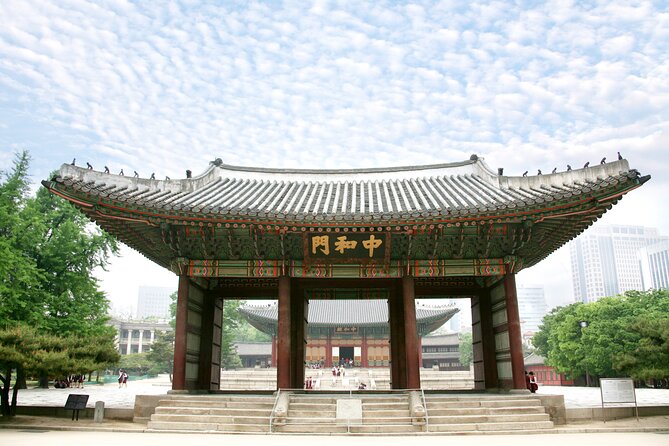
Junghwajeon: the main throne hall under evening light
Your first big stop is Junghwajeon, identified as the main throne hall. This is the kind of place where self-guided sightseeing can leave you with photos and labels, but not a clear sense of what mattered.
With a guide, you get the story behind the function and the symbolism. You can also better spot the architectural layout. At dusk, the hall’s shape and the relationship between open space and structured rooms stand out more clearly than they do in bright daylight. You start to see how power and ceremony were staged in a physical way.
This is the moment where the night timing pays off most. Daylight can flatten details, especially around roof edges and the rhythm of columns. At night, shadows do some of the explaining for you.
Seokjojeon: the Western-style building that changes the whole frame
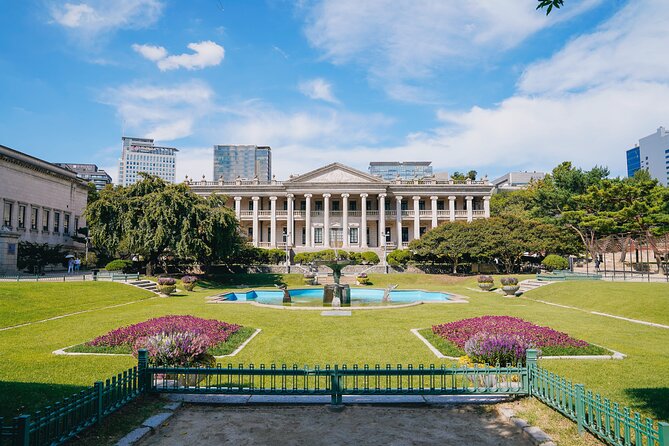
If Junghwajeon sets the traditional baseline, Seokjojeon is where Deoksugung becomes a living story of change. Seokjojeon is the Western-style building on the grounds, and it’s one of the palace areas most people remember after the tour.
The value here is not just that it looks different. It’s that a guide can explain why the building is part of a bigger modernization period. The palace is tied to Korea’s early attempts to modernize after centuries of older dynastic patterns. When you understand the era, the Western-style structure stops feeling like a random foreign addition and starts feeling like a decision made in a time of pressure and transition.
At night, you’ll also notice how the lighting changes the feel of the building. You can compare it mentally to the traditional halls, because you’ve already seen the contrast as you move through the site.
Other things that start after dark in Seoul
- Seoul: Night Market Food Tour with Local Guide
★ 4.9 · 943 reviews - Seoul: Evening Dark History, Folklore & Ghost Story Walking Tour
★ 5.0 · 593 reviews - Small-Group Night Food Tour in Seoul with Korean BBQ
★ 5.0 · 304 reviews - Seoul Night Palace & Market Food Tour with Vehicle
★ 5.0 · 275 reviews - Seoul: Guided City Wall Sunset Hike with Korean Dinner
★ 4.9 · 227 reviews
Seokeodang: a favorite building connected to King Gojong
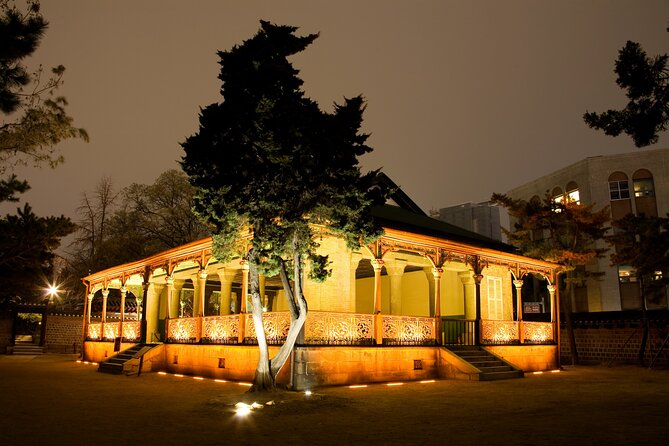
Next up is Seokeodang, described as the most beloved building by King Gojong. That detail gives you an angle. Instead of treating the palace as a set of government rooms, you start to think about it as a place where a specific ruler spent time, made choices, and created preferences.
This stop is a good one for people who like the human side of history. You’re not only looking at official functions. You’re being guided toward what a king valued, and why that matters for how you interpret the space.
One practical benefit: this kind of story also helps you keep attention through the whole 2-hour timeframe. If you’ve ever done “list of halls” tours, you know how easy it is to check out halfway. Anchoring each stop with a concrete connection, like Seokeodang and King Gojong, makes the pacing feel smarter.
Hamnyeongjeon: the king’s bed-chamber and the feeling of daily life
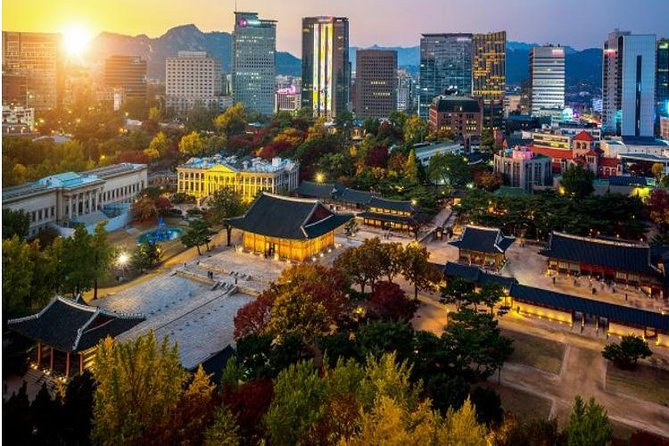
The tour then moves to Hamnyeongjeon, identified as the king’s bed-chamber. This is where Deoksugung becomes less ceremonial and more intimate.
A bed-chamber stop can go one of two ways on a tour: either it becomes vague, or it becomes meaningful. A strong guide makes it meaningful by linking private space to the broader court culture. You start to understand how the palace was not only a stage for public power, but also a setting for the ruler’s daily life and comfort.
This stop is particularly effective in the evening because you’re already in a more reflective mood. Daytime tours can feel like a checklist. Evening tours make you slow down enough to notice the atmosphere.
Jungkwanhun: the cafeteria stop that doubles as a Q and A moment
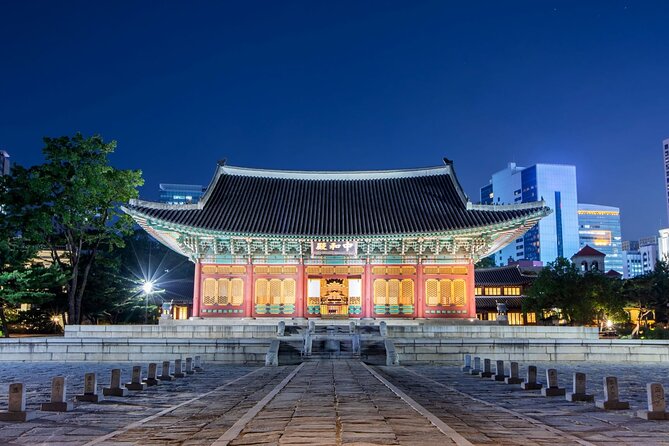
You end at Jungkwanhun, listed as a cafeteria. Yes, it’s a break point, but it’s also a chance to wrap up questions while the group is still together.
This is where you can ask direct questions about what you just saw. The tour is set up for interaction, and having time at the end helps you get answers when your questions are freshest. If you care about architecture, you’ll probably find it useful to ask how the layout and the style differences connect to the era.
Also, if you’re thinking, I might want a drink or a snack after, this end point makes that easier. You’re finishing near central streets, so it’s not like you’re sent deep into nowhere after your tour is done.
The stone wall beside Deoksugung: a quick stop you should not skip
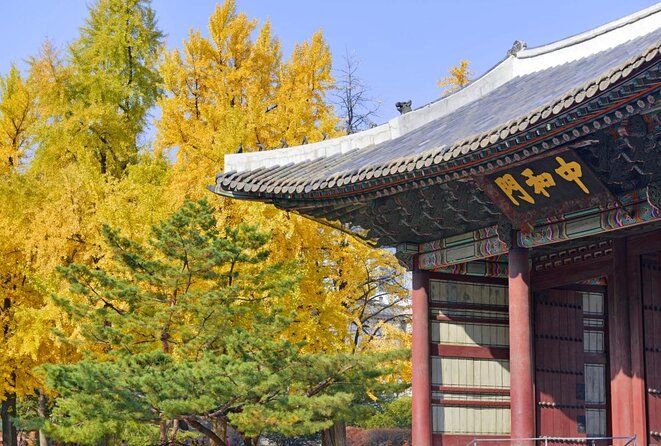
There’s one outside-the-rooms detail worth flagging: the stone wall next to Deoksugung Palace. It’s called out as famous for its beauty, and at night it’s exactly the kind of feature that can look bland in daylight but dramatic in evening light.
If your guide encourages a quick look around the grounds, take it seriously. This is one of those small add-ons that can become the best photo you take all evening, because it frames the palace differently than the main halls.
Price and value: $35 for guidance and context, not just entry
At $35 per person for about 2 hours, this tour sits in the “fair value” zone because admission is free. You’re not paying entry fees on top of the guide. You’re paying for interpretation, navigation, and the ability to understand what you’re looking at while you’re there.
So the real question is: do you want a guide’s perspective, or do you want to self-walk and read signs? If you like architecture and historical context, the cost makes sense. The tour gives you explanations in English and Chinese, and you can ask questions.
If you’re the type who just wants photos and doesn’t care about meaning, you might spend less by going solo. But for most people, $35 for a guided evening stroll through multiple key buildings plus context feels reasonable, especially in a central location near major subway lines.
The average booking time is about 45 days in advance. That’s a clue that popular time slots can fill up, so plan ahead if you want a night tour around a specific day.
Guides and the difference good storytelling makes
The quality of guides shows up in the way the palace is explained, not just in accuracy. In the examples you’ll see from past participants, guides like Alan Han are praised for giving a great tour and for connecting the story of the end of the Joseon dynasty to what you see in the architecture. Another guide, Lee (noted as arriving on time and acting as a skilled narrator), stands out for story delivery and historical framing.
What you should take from that, as a traveler, is simple: this tour is built around telling you why each building matters. If you value that, you’ll likely enjoy it more than a “here’s a hall, take a picture” approach.
One more rule to respect: recording or filming during the tour isn’t allowed. If you’re hoping to capture everything for later, plan to enjoy the moment in real time and rely on your own photos where permitted.
Who should book this night tour?
This is a great fit if you:
- Like architecture and want help seeing differences between traditional and Western-style elements
- Want an easier evening plan near City Hall and Gwanghwamun Station
- Enjoy Q and A time, instead of only reading placards
- Are visiting Seoul and want a more atmospheric palace experience than the daytime crowd
It’s also a decent choice if you’re on a tight schedule. Two hours is long enough to cover multiple key buildings without turning the outing into a half-day project.
If your interests lean mostly toward museums, shopping, or long walking routes, you might feel like this is too short. But for palace-focused travelers, the length is a sweet spot.
Should you book Deoksugung Palace Night Tour?
I’d book it if you want your palace visit to come with context. Deoksugung’s mix of traditional and Western-style architecture is the kind of thing that needs guidance to fully land, and the night timing makes the grounds feel calmer and easier to take in. The fact that admission is free at $35 is also a practical win.
I’d think twice if you:
- Are only interested in quick photos and don’t care about history or architecture
- Are traveling on a Monday, since Deoksugung is closed and you’ll need an alternative
- Need flexibility, because weather and group minimum rules can affect whether the tour runs
Overall, this tour is one of those plans that respects your time. You get the key spaces, the right framing for the era, and a peaceful evening setting where questions make sense.
FAQ
Where do I meet for the Deoksugung Palace night tour?
You meet in front of Exit 1 of City Hall Station (Line 1 and 2). The tour address is listed in Jung District, Seoul, and the tour ends at Jeonggwanheon on Sejong-daero.
How long is the tour?
The duration is about 2 hours.
Is the palace admission included?
Yes. The tour notes admission ticket free.
What languages are the explanations in?
The tour provides explanations in English and Chinese.
Is Deoksugung Palace open every day?
No. On Mondays, Deoksugung Palace is closed, and you can book the Gyeongbok Palace tour instead.
Is recording or filming allowed?
No. Recording or filming the tour is not allowed.
How large are the groups?
This experience has a maximum of 20 travelers.
What happens if weather is bad or not enough people book?
The tour requires good weather. If it is canceled due to poor weather, you will be offered a different date or a full refund. If the minimum number of travelers is not met, you will also be offered a different date or a full refund.
Can I bring a pet?
No. Pets are not allowed.
Keep Browsing Seoul

More Seoul Write-Ups
Palaces, Three More Ways
Fresh on the Seoul pile
- Unique Native Experience : Han River Picnic, Board game, BBQ★ 5.0 · 3 reviews
- 2-Hour Private Kayaking and Paddleboarding Experience in Hanriver★ 5.0 · 3 reviews
- Korean Folk Village & Suwon Hwaseong Fortress Private Tour★ 5.0 · 3 reviews
- Seoul Korean BBQ Dinner Experience with Secret Food Tours★ 5.0 · 3 reviews
- Seoul Highlights & Hidden Gems – Private Tour with Photo Service★ 5.0 · 3 reviews
- Night Food Tour in Seoul with Traditional and Modern Cuisine★ 5.0 · 3 reviews
Seoul Royal Palaces you might have missed.
 ★ 4.9Seoul: Gyeongbok Palace, Bukchon Village, and Gwangjang TourFrom $322,321 reviews
 ★ 5.0Best Seoul City Tour (Gyeongbokgung Palace,Insadong,Namsan Tower)From $581,647 reviews
 ★ 5.0Small-Group Royal Palace and Seoul City Tour (hotel pick-up)From $561,474 reviews
★ 5.0Seoul: Gyeongbok Palace, Bukchon Village, and Gwangjang TourFrom $321,044 reviews
★ 5.0Small-Group Royal Palace and Seoul City Tour (hotel pick-up)From $561,474 reviews
★ 5.0Seoul: Gyeongbok Palace, Bukchon Village, and Gwangjang TourFrom $321,044 reviews
 ★ 4.7Seoul Highlights: Gyeongbok Palace, Insadong & N Seoul TowerFrom $26726 reviews
 ★ 4.6Seoul: Hanbok Rental with Gyeongbokgung Palace EntryFrom $6611 reviews
 ★ 4.5Seoul City Half Day Tour-Gyeongbok Palace Guard Changing CeremonyFrom $38357 reviews
 ★ 4.5Seoul: Gyeongbok Palace with Gigibebe Hanbok RentalFrom $9289 reviews
Where this tour also appears